Vermont’s Environmental Priorities, Housing, Energy and Affordability with ANR Secretary Julie Moore
Tuesday, September 15, 2026, Common Sense Radio with Bill Sayre, weekdays, 11 o’clock till Noon.
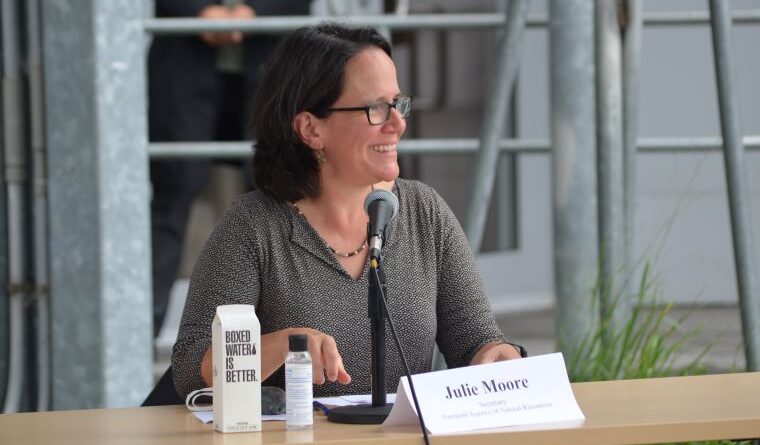
Julie Moore, Secretary of the Vermont Agency of Natural Resources, joins Bill with an update on Vermont’s Environmental, Climate, and Natural Resource Priorities, how best to achieve balance among these priorities, and balance with other public policy priorities. Also, the role of legislation, regulation, and voluntary action in achieving that balance — with special emphasis on changes made in the last Legislative Session, and under consideration for further change.
Potential Questions and Issues.
Act 181 was much maligned in the last year or so. Some of the worst parts of Act 181 were repealed. But we sometimes forget that there were good parts of Act 181. What was the purpose of Act 181, and what were the Act 250 reforms in Act 181 that were helpful in eliminating duplicative regulations. What are some examples? Various measures of water and air quality, and how they are effected by development. Since Act 250 was adopted in 1969 or 70, what Agency of Natural Resources regulations have been adopted, that duplicate parts of Act 250? In Act 181 what are Tier 1A, and Tier 1B, and how are those lands regulated? What were the changes in Act 181’s Tier 3 and the Road Rule, and how will those changes be helpful to rural landowners and rural communities?
Are there additional rules, temporary I believe, that allow the addition of an Accessory Dwelling Unit, to an existing residential unit? What will be the effect of the Executive Order regarding Wetland areas? Do you think there will be any significant effect on wetland functions?
What should we know about the Community Housing Investment Program (CHIP), and its role in orderly development, that protects the environment? How is CHIP, in a way, a work-around to the adverse effects of a Statewide Property Tax?
What should we know about the rules and regulations under consideration as a replacement for Tier 3 designation? What was the purpose of Tier 3? How did the language change when it was repealed? The purpose was to protect sensitive environmental areas? How do we best achieve that goal?
What is the effect of losing the Finch Paper Company pulp market — about 500,000 tons per year? How does this affect the practice of sound forestry? What will be the effect on loggers, and eventually landowners? Why do many consider the Use Value Appraisal the most effective and successful forestland conservation program in Vermont history? How and why is that so?
What is the current status of the 3 acre rule and its effect of water quality and small business?
What is the 30 by 30, and 50 by 50 Conservation Program? Why is the definition of conservation critical to interpreting the way this program is implemented? Is it underway in all or most all of the 50 States? Should UVA lands quality a conserved lands?
What other public benefits a produced by our forests, particularly working forests? Wildlife, songbirds, hunting, fishing, trapping, camp culture, snowmobiling, scenic beauty for tourists and residents alike, also, products, services, employment opportunity, as well as clean water and clean air.
What should we know about the Global Warming Solutions Act (GWSA)? Did the Act convert aspirational goals into regulatory Mandates — with the potential for most anyone to sue the Secretary, if the Mandates are not attained. Some believe that we do not get serious about achieving aspiration goals, unless and until they are converted into mandates. Does that seem true to you? Were we making progress before the GWSA? What are the challenges in measuring the targets? What problem does this create for regulatory mandates, subject to lawsuit, as a right of private action?
What is a private right of action? Wha will be the costs to the Agency from the exercise of a private right of action? Is there a philosophical question as to who best represents the public interest? What are the Greenhouse Gas Goals, now mandated by law — for 2025; 2030, and 2050? Have we made respectable progress in reducing Greenhouse Gases in recent years? How much progress? How have we achieved this progress? What is the law of diminishing returns? How does it apply here? And the principle of opportunity cost? And its connection to the affordability crisis for Vermont families and businesses?
Is there a danger, if the law and regulation are not changed, that building a home in a rural Vermont will be affordable only by the wealthy, not for middle class families, especially young families. Is there a danger of elitism, with similarities to the feudal estates from which our forefathers and foremothers sought to escape. And the risk of creating, if the law does not change, of creating a rural theme park — a great place to visit, or to live if you can afford it, but a very difficult place to earn a living.
What else should we know about the other connections between energy policy and environmental policy, and affordability? Heating our homes, fueling our transportation, manufacturing, and electricity generation. What was the problem with the Clean Heat Standard? An indirect, cumbersome and costly way to impose a Carbon Tax?
Will a Carbon Tax disproportionately affect rural the cost of living for rural households and communities, and the competitiveness of Vermont businesses?
Is wood a renewable resource? Is wood energy renewable energy? How does the way in which we look at the size of the forest tract being considered affect the degree to which the forest is considered renewable? For example, one tree, one stand, one woodlot, one watershed, or the State. How much of the forest is harvested in any given year — less than one percent, and in many cases only a thinning, with most of the canopy left in tact. And that we harvest only about a third to half of the volume of timber that we grow every year? Can this same approach be used to look at the process of absorbing and storing Carbon? Should we remember that solid wood products store Carbon, sometimes for generations? What about Mass Timber — which has now been shown to be meet standards of structural soundness, and fire resistance for buildings as high as 18 stories.
As part of decarbonizing our fuel sources, should we be considering nuclear energy? Are there new technologies that are safer, recycle the fuel, as well as reduce the Carbon footprint. What do James Hanson and Patrick Moore think about this approach? Has any society ever prospered with abundant, affordable, and reliable energy? Likewise, has any society prospered without a large and growing middle class, with an affordable cost of living. What are the implications of Vermont’s demographic trends for a large and growing middle class in Vermont?
Should we consider allowing a Data Center to locate in Vermont, perhaps at the site of the former Vermont Yankee energy plant, where the infrastructure already is in place? And perhaps in combination with some of the new technology for nuclear power, such as the fluid bed reactors, with much less waste product, and more recyling of fuel?
How will the exponential increase in the use of Artificial Intelligence affect environmental policy choices, and energy policy choices?
What should we know about the updates the current status of water quality issues. Vulnerability to flooding? And the cost and benefit of investing in infrastructure resilience, as compared with emissions control? Also, waste water? What should we remember, often forgotten, from 150 years ago about the connection between environmental policy and public health policy — in creating infrastructure for clean water, and disposal of wastewater?
How should this affect our priorities? Have we resolved the minor question of jurisdiction between the Agency of Natural Resources and the Agency of Agriculture, over water quality, likely stormwater runoff, on our large farms? And with the Paraquat issue?
A few years ago, much in the news were water quality issues in Franklin County and Lake Champlain? Sino-bacteria, I believe. Have those issues been addressed, in whole or in part?
And the status of PCBs in our schools? What are the issues? Are there other buildings for which this may be a problem?
On The Notch Radio, WMTK, 106.3 FM, and on affiliated radio stations of Green Mountain Broadcasters, in Orleans County, Wike 1490 AM or 103.1 FM, in Caledonia County, WSTJ 1340 AM or 104.1 FM, or directly on your phone or computer anywhere in the world with internet access, with Live Streaming from the Notch