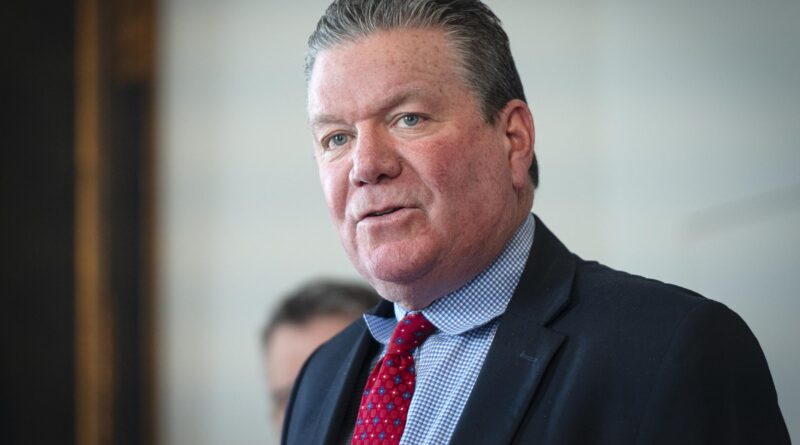
Vermont Tax Commissioner Bill Shouldice Discusses Tax Revenue, Property Taxes and Affordability
Thursday, September 10, 2026, on Common Sense Radio with Bill Sayre, 11 o’clock till Noon.
Bill Shouldice, Vermont Commissioner to Taxes, joins Bill with an update on Vermont tax receipts, and the outlook for receipts in the year ahead — with special emphasis on the effect of changes in tax law. And how tax law should be changed to make living and working in Vermont more affordable.
Potential Questions and Issues.
For the fiscal year completed in June, can you summarize the amount of tax revenue received — by type of tax. And compared with expectations, and compared with a year earlier. Income Tax (Personal and Corporate), Sales Tax, Rooms and Meals Tax, Gasoline Tax, Property Taxes, Purchase and Use Taxes, Payroll Taxes. Are fees collected by the Tax Department? And how about Lottery Proceeds? If we had a Carbon Tax, would it be collected by the Tax Department?
Who creates the estimates of expected tax revenue, and how do they do so?
What changes in tax law were made in the last Legislative Session, and how has that affected taxpayers and tax revenue? Can we discern how these changes have affected taxpayer behavior?
Which taxes are dedicated to a particular purpose? What are the advantages and disadvantages of dedicating a particular purpose? What is the issue created by changing engine efficiency in the use of gasoline, as well as changing proportions of hybrid vehicles and electric vehicles?
What should we know about the changes in law that affect property taxes? The Yield bill? Does the Statewide Property Tax create a disconnect between School District Spending and the tax rates that District Taxpayers pay? If District Spending and District Tax Rates were more closely connected, would District spending decisions be made more carefully? Is this an example of the principle that government governs best, when it is closest to the people who pay the taxes and receive the benefit?
What proportion of property taxpaying households, have their tax payment sensitized to their income? About two thirds? From where does the subsidy come? The highest one third? Or was the overall rate raised sufficiently to cover the subsidy?
How will the Foundation Formula work and Excess Spending thresholds work to reconnect spending with taxes? Will Districts that spend more per student than the State wide average have to pay the excess with higher taxes in their own District? And that Districts who spend more than the excess spending threshold (define) pay double the excess is District taxes? Will Districts that spend less than the Statewide average per student, pay lower property? How will that work?
What is the history of reducing the increase in property taxes by creating or raising another tax? Rooms and Meals Taxes, Sales Taxes, Income Taxes, Statewide property taxes. Is controlling spending (fiscal restraint) the only sustainable way to control taxes, apart from economic growth?
How does fiscal restraint in combination with economic growth, increase affordability? And how does affordability increase economic growth? Why is it important for government, like households and businesses, to live within its means? When government lives within its means, does government have more means within which to live?
How does economics growth equate to growing standards of living for Vermont households, and provide the funding for essential government services and income support, without raising tax rates? How does this process become self-reinforcing as the economy grows, and tax revenue grows without raising tax rates, helping the economy grow even faster, and perhaps even allowing reductions in tax rates? Is this process underway, perhaps in Florida, Texas, the Carolinas, and Tennessee? And the same principle in reverse in California, New York, Massachusetts, Illinois, and New Jersey?
What proportion of individual income taxes are paid by the highest income earners (1 percent)? About 1,500 households? Perhaps 25 percent? What proportion of income taxes are paid by the highest 10 percent? Is that more than the lowest 90 percent? And the highest 50 percent — almost all the income taxes? How many households are there? What proportion pay income taxes? What proposals were there for an even higher tax on high earners? How would this compare with similar taxes in California, Massachusetts, and New Jersey? For example, the threshold at which the higher tax would be imposed? Sometimes we hear that higher income people households should pay their fair share? In light of the above proportions, what is fair share? Is the newly created special category of Property Taxes, for second homes, another example of a tax targeting high earners?
Is it understandable, therefore that some feel that our tax structure has the effect of punishing people who are high earners? Does this help explain why the number of middle income households, particularly young families, is declining? What are the unintended consequences making it so difficult for middle income families to afford to live in Vermont? For school populations — particularly rural school? And for rural hospitals? For housing markets?
What if we ask the same questions for property taxes? At what level of income do property tax payer cease receiving a subsidy to reduce their property taxes? Is there a calculation of how much extra is paid by household above that thresholds pay, to subsidize households below that threshold? And similarly for other income support programs — housing vouchers, food vouchers, child care subsidies, transportation subsides, sliding scale subsidies in other products and services.
What should we know about the separate tax on second homes? Is this another example of attempting to impose higher taxes on the economically successful?
What should we know about the earned income tax credit? How is it a better approach to income support than a minimum wage law?
Also about the CHIP and TIF programs?
What have we not discussed that is important to know about Vermont’s tax structure/
On The Notch Radio, WMTK, 106.3 FM, and on affiliated radio stations of Green Mountain Broadcasters, in Orleans County, Wike 1490AM or 103.1FM, in Caledonia County, WSTJ 1340AM or 104.1FM, or directly to your phone or computer anywhere in Vermont, or anywhere in the world, with internet access, via live streaming from the Notch’s web site.